Page 20 - The Waioeka Journey Booklet
P. 20
White Island >
White Island >
The columns at Opato and Matahanea provide a gateway to your journey The origins of the tribe Te Aitanga a Mahaki, who are the original inhabitants
through the Waioeka Gorge. They act as pou, signalling the long occupation of this part of the Waioeka Gorge, stem from the marriage of Tauheikuri and
by tangata whenua that sits beneath the gorge’s more recent stories of T T T T
Tamataipunoa. Their story illustrates the ancient connections and boundaries
Tamataipunoa. Their story illustrates the ancient connections and boundaries amataipunoa. Their story illustrates the ancient connections and boundaries amataipunoa. Their story illustrates the ancient connections and boundaries amataipunoa. Their story illustrates the ancient connections and boundaries amataipunoa. Their story illustrates the a
farming, road and bridge-building exploits.
between people of the northern and southern coasts of East Cape.thern and southern coasts of East Cape.thern and southern coasts of East Cape.thern and southern coasts of East Cape.thern and southern coasts of East Cape.
between people of the nor
between people of the nor
between people of the nor
between people of the nor
between people of the northern and southern coasts of East Cape.
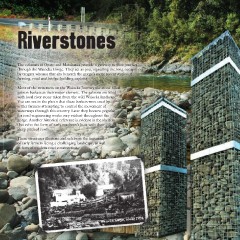
Most of the structures on the Waioeka Journey use stone-fi lled
gabion baskets as their major element. The gabions are fi lled The great chief Kahungunu offered his
with local river stone taken from the wild Waioeka landscape. youngest daughter Tauheikuri to Tutamure.
You can see in the photo that these baskets were used by Tutamure was the son of Kahungunu’s
settler farmers attempting to control the movement of nephew Haruataimoana, who lived in Opotiki.
waterways through this country. Later they became popular Tauheikuri went to meet with him and became
for road engineering works very evident throughout the confused as Tutamure was with his brother
gorge. Another historical reference is evident in the shelters Tamataipunoa. One was handsome, the other
that echo the form of early roadman’s huts with their not so. Tauheikuri approached the handsome
steep-pitched roofs. Tamataipunoa at which Tutamure got up in
disgust and went to look at himself in a still
These structures illustrate and celebrate the ingenuity pool of water.
of early farmers facing a challenging landscape, as well He returned and told his brother to take
as feats of modern road construction. Tauheikuri and never return.
Maunga a Kahia (Mahia) > “Kei no koe takahi i runga o Motu, kei kite koe
i to puia o Whakaari noho iho, he konei - You
may look on the smoke of White Island (in the
Bay of Plenty) but come no further.”
This they did with Tauheikuri and Tamataipunoa
remaining together at Maunga a kahia (Mahia).
They had two sons, Tawhiwhi and Mahaki.
Hence a separation was established from
Whakatohea, (eastern Bay of Plenty tribe)
with the emergence of Te Aitanga a Mahaki.
Trafford Homestead, Waioeka Gorge, about 1924.
Trafford Homestead, Waioeka Gorge, about 1924.
Trafford Homestead, Waioeka Gorge, about 1924.
White Island >
The columns at Opato and Matahanea provide a gateway to your journey The origins of the tribe Te Aitanga a Mahaki, who are the original inhabitants
through the Waioeka Gorge. They act as pou, signalling the long occupation of this part of the Waioeka Gorge, stem from the marriage of Tauheikuri and
by tangata whenua that sits beneath the gorge’s more recent stories of T T T T
Tamataipunoa. Their story illustrates the ancient connections and boundaries
Tamataipunoa. Their story illustrates the ancient connections and boundaries amataipunoa. Their story illustrates the ancient connections and boundaries amataipunoa. Their story illustrates the ancient connections and boundaries amataipunoa. Their story illustrates the ancient connections and boundaries amataipunoa. Their story illustrates the a
farming, road and bridge-building exploits.
between people of the northern and southern coasts of East Cape.thern and southern coasts of East Cape.thern and southern coasts of East Cape.thern and southern coasts of East Cape.thern and southern coasts of East Cape.
between people of the nor
between people of the nor
between people of the nor
between people of the nor
between people of the northern and southern coasts of East Cape.
Most of the structures on the Waioeka Journey use stone-fi lled
gabion baskets as their major element. The gabions are fi lled The great chief Kahungunu offered his
with local river stone taken from the wild Waioeka landscape. youngest daughter Tauheikuri to Tutamure.
You can see in the photo that these baskets were used by Tutamure was the son of Kahungunu’s
settler farmers attempting to control the movement of nephew Haruataimoana, who lived in Opotiki.
waterways through this country. Later they became popular Tauheikuri went to meet with him and became
for road engineering works very evident throughout the confused as Tutamure was with his brother
gorge. Another historical reference is evident in the shelters Tamataipunoa. One was handsome, the other
that echo the form of early roadman’s huts with their not so. Tauheikuri approached the handsome
steep-pitched roofs. Tamataipunoa at which Tutamure got up in
disgust and went to look at himself in a still
These structures illustrate and celebrate the ingenuity pool of water.
of early farmers facing a challenging landscape, as well He returned and told his brother to take
as feats of modern road construction. Tauheikuri and never return.
Maunga a Kahia (Mahia) > “Kei no koe takahi i runga o Motu, kei kite koe
i to puia o Whakaari noho iho, he konei - You
may look on the smoke of White Island (in the
Bay of Plenty) but come no further.”
This they did with Tauheikuri and Tamataipunoa
remaining together at Maunga a kahia (Mahia).
They had two sons, Tawhiwhi and Mahaki.
Hence a separation was established from
Whakatohea, (eastern Bay of Plenty tribe)
with the emergence of Te Aitanga a Mahaki.
Trafford Homestead, Waioeka Gorge, about 1924.
Trafford Homestead, Waioeka Gorge, about 1924.
Trafford Homestead, Waioeka Gorge, about 1924.